The theatre
A century in one basement
Four names, one room: the Bungalow Theater (1911), the Gaslight (1964), the Denver Victorian Playhouse, and the theatre everyone simply called The Vic.
“Most wonderfully, magic again is being made on the stage Swartz carved out of his basement 94 years ago… Take the leap. As it is with young love or old love rekindled, something wonderful awaits below.”
In the late 1800s George Swartz moved to Colorado to seek treatment for his tubercular lungs. Swartz was a great lover of Shakespeare, and as part of his treatment regime he began to read aloud from the Bard’s works. His family would gather to hear him in the evenings, and as time passed so did a growing circle of friends and curious neighbours. When he began to build his new house on the northwest side of Denver, he designed a theatre in the basement to accommodate his growing audience.
The Bungalow Theater, 1911–1937
Finished in 1911, the Bungalow Theater included a miniature proscenium with terraced seating and benches along the walls. There was also an open orchestra pit, later covered by the stage apron. It was in many ways the original home theatre. With the help of his family and friends, Swartz was able to stage all of Shakespeare’s plays, and local legend has it that the Bungalow was the first theatre west of the Mississippi to have done so.
That claim is the founding story of the building and it was repeated in the theatre’s own copy for a century. It should be read as the tradition it is rather than as a documented record — the surviving evidence for Denver’s early amateur stages is thin, and the city’s theatrical history of this period is held in fragments by institutions such as Denver Public Library’s Special Collections and Archives. What is not in doubt is that a private house in a residential street contained a working proscenium stage in 1911, which is unusual anywhere.
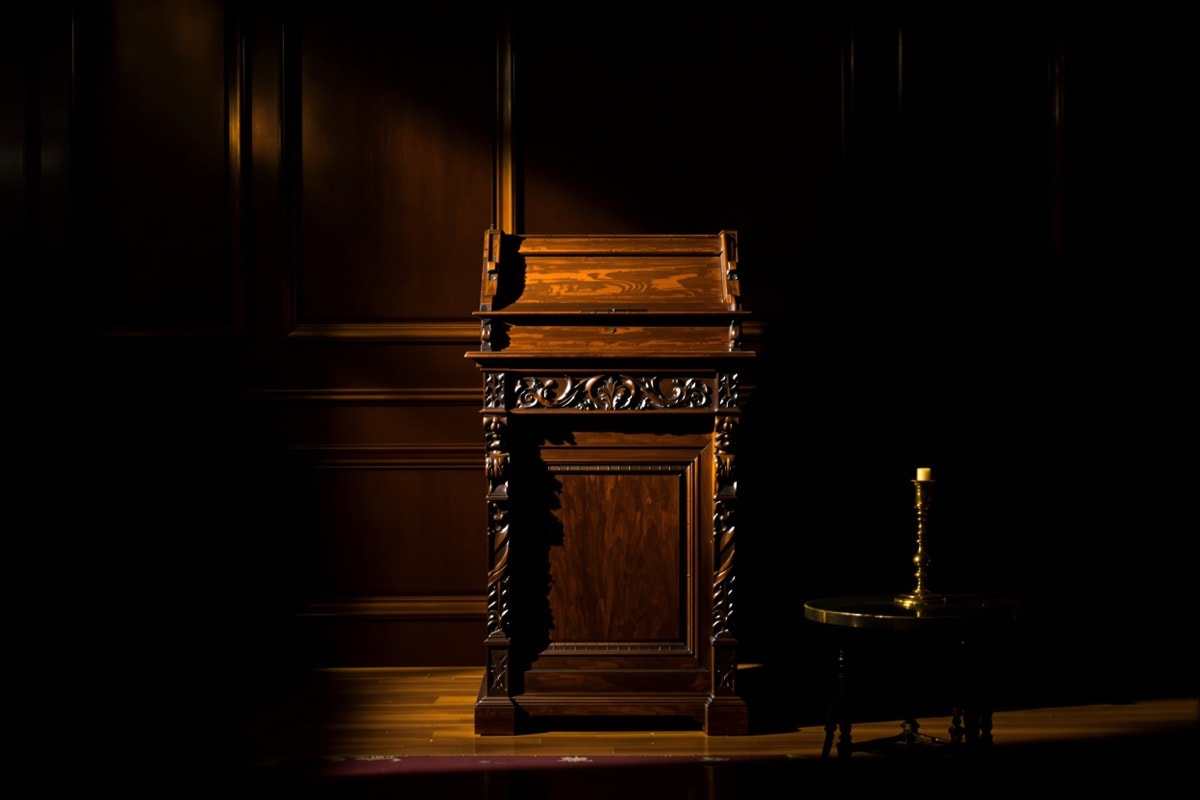
What intimacy asks of a stage
A miniature proscenium and terraced seats do more than establish atmosphere; they set the scale of every choice made inside the room. On a basement stage, an entrance is completed within a few steps and a quiet turn of the head can be legible from the back row. Broad gestures or needless movement can crowd the picture. Directors working in rooms of this size generally have to treat stillness, pace and exact placement as part of the architecture rather than as decoration added after rehearsal.
Sightlines are equally local. A spectator at the side sees a different composition from someone on the centre line, while a low stage or covered orchestra pit can make furniture and seated actors disappear behind the people in front. Terracing helps, but it does not remove the need to check a scene from every part of the house. Chairs, tables and floor work must be tested against those views; a performer who is perfectly visible in one seat may be masked in another.
That closeness also changes tone. Faces carry more detail, voices arrive without amplification and scenery is examined from only a few yards away. Materials, joins and practical objects have to withstand scrutiny, while lighting has little distance in which to soften an edge. The reward is concentration: when scale, sightline and sound are handled carefully, a small room can make the audience feel less like observers across a divide and more like witnesses sharing the same air.
Between the theatres, 1937–1956
After Swartz’s death in 1937 the building served as meeting space for various organisations. It housed a local church congregation from 1944 to 1954 and was later used as meeting space by a scouting group. For the better part of two decades the stage sat unused beneath a house that had gone back to being a house.
The Gaslight, 1956–1984
In 1956 the theatre was re-established with the arrival of Paul Willett. Renamed the Gaslight in 1964, under Willett’s direction the venue gained national attention for its regional premieres of Equus, Slow Dance on the Killing Ground and Arthur Miller’s The Price — a run of uncompromising programming in a quaintly old-fashioned room, which is a large part of why the place was remembered so warmly afterwards.
Willett was creative director until his death in 1984, and the habits he set outlived him. Tea, coffee and biscuits served to the audience in the living room above the theatre during the interval remained a house tradition through every subsequent management. So, according to everyone who worked there, did his ghost.

The Denver Victorian Playhouse, 1984–2011
During the next two decades the theatre was renamed the Denver Victorian Playhouse and passed through various hands. It closed in 2000, and in May 2005 it was taken over by Wade and Lorraine Wood, who reopened it that September with The Voice of the Prairie. The theatre’s own description of its aim under the new management was simply to carry on the tradition of providing entertainment that had begun there in 1911. It ran as a Colorado non-profit corporation.
Over the following six years the Vic staged something in the region of fifty productions, hosted visiting companies, and drew regular notice from The Denver Post, Westword, the North Denver Tribune and the city’s theatre blogs. It collected two Henry Award nominations from the Colorado Theatre Guild in 2010 and three Ovation Award finalist places in 2009. The full record is in the production index.
The end, 2011
The last full production, John B. Keane’s The Field, closed on 2 April 2011, and a staged reading of The Seagull King on 7 and 8 April was the final performance in the room. The house was put up for sale and drew an offer within seven days; the sale closed on 3 May. Under the terms of the sale the seventy-six seats and all theatre equipment had to be removed before completion, and the buyer — a neighbour — converted the building back to an ordinary family home. An estate sale disposed of the lighting equipment, props, sets and antique furniture.
Denver has a formal mechanism for protecting buildings of this kind through Denver’s Landmark Preservation office, and the federal National Park Service historic preservation programme supports the rehabilitation of historic structures, but nothing of that sort applied here. What made the Vic significant was a room in a private basement, not a facade, and no designation existed that could have kept a stage in it.
The theatre is remembered in Denver as a place rather than as a company. That is the honest summary: for a hundred years, a house on a residential street had a working theatre under its floor, and now it does not.
A note on contact details. The Denver Victorian Playhouse no longer exists as a venue or as an operating company. The building is a private home, and former contact routes no longer lead to a theatre.